
Audio or Paper Guestbook: Which Is Right for Your Event?
Compare audio and paper guestbooks for emotion, simplicity, keepsakes and remote participation to find the right fit for your event.
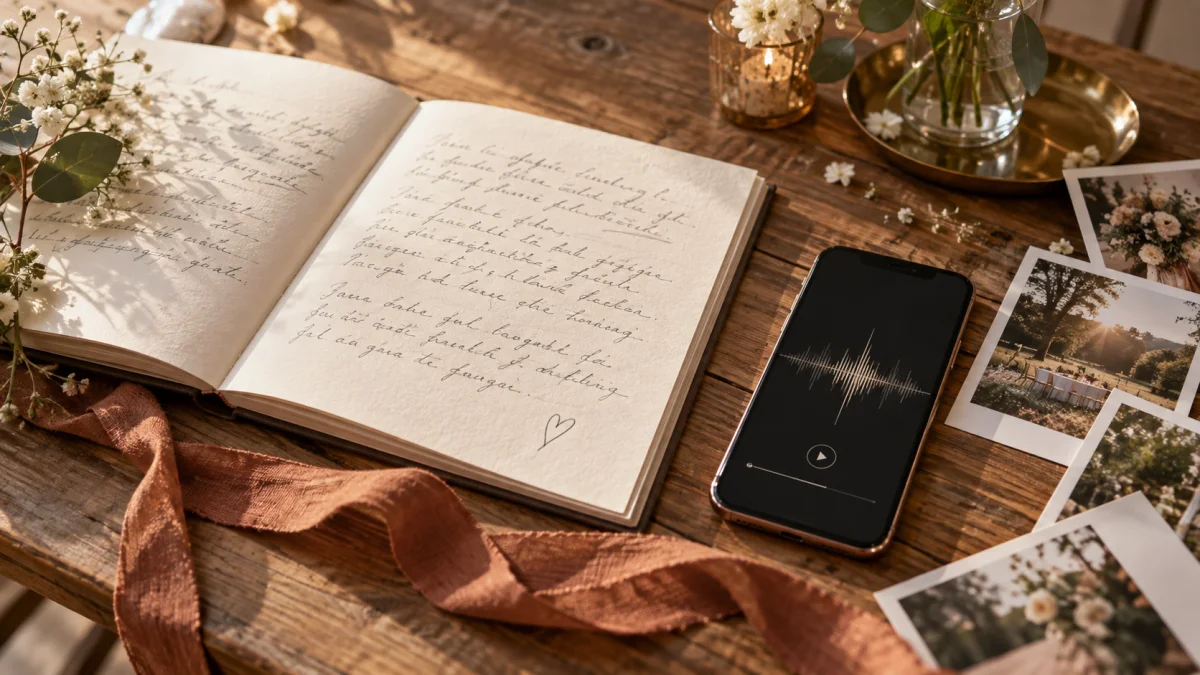
A paper guestbook is a familiar part of many weddings and birthdays. An audio guestbook adds another dimension: voices, pauses, accents and laughter. Do you have to choose between them? It depends on the experience you want to offer your guests and how you would like to revisit the day.
What each format really keeps
Paper gives you something you can hold. You recognise someone’s handwriting, a quick drawing, a signature or a carefully arranged page. It is easy to flip through and display with the rest of your family albums.
Audio keeps a person’s presence. An emotional voice, a laugh halfway through a story or a conversation between loved ones can carry nuances that writing cannot. Paired with photos, it brings a moment back to life rather than leaving you with a sequence of dedications.
Audio and paper guestbooks compared
| Feature | Paper guestbook | Audio guestbook |
|---|---|---|
| Type of keepsake | Handwriting, drawings and signatures | Voices, stories, emotions and photos |
| Participation | In person, one guest at a time | From a phone, in person or remotely |
| Set-up | A book, pens and a dedicated table | A QR code or link, with no special recording equipment |
| After the event | A physical item to keep | A private gallery and downloadable files |
| Spontaneity | Often short, considered notes | Spoken stories, conversations and laughter |
Paper is a great choice if you love tangible keepsakes
Choose paper if you value the act of writing and want a beautiful object as part of the décor. It is especially good for guests who enjoy drawing, adding an instant photo or creating a visual message.
The main challenge is organisation. You need a well-lit spot, several working pens and someone to invite guests to take part. One book can also create a queue when everyone wants to write at the same time.
Choose audio when you want to hear their stories
Audio is particularly moving when several generations come together. It can keep a grandparent’s voice, a childhood friend’s story or a message from someone who could not travel. Each person uses their own phone after scanning a QR code, with no app to install.
Guests can contribute during the period you set. They record whenever they find a quiet moment, listen back and start again if they want. Their messages then appear in your private space.
Why the two formats work so well together
You do not have to choose just one. Place the paper guestbook and QR code together in a small memory corner. Guests can write a note, record their voice, add a photo or do all three.
This gives everyone a way to take part that feels comfortable. Someone who is less keen on recording may choose paper; another guest may find it easier to share their memory aloud. You will have an album to flip through and a living collection to listen to.
Four questions to help you decide
- Would you rather read their words or hear their voices again?
- Will some loved ones contribute remotely or after the event?
- Can someone look after the paper book and invite guests to use it?
- Do you want to download and back up each digital memory easily?
If voices and remote participation matter most, learn how the Memolith audio guestbook works. For a wedding, you can also offer both formats and place the QR code beside the paper guestbook or photo booth.
Keep your memories safe after the celebration
Protect a paper guestbook from moisture, direct sunlight and repeated handling. Consider scanning its most important pages. For audio and photos, download a complete archive and keep at least two copies on separate devices or storage locations.
The best guestbook is not necessarily the most modern or the most traditional. It is the one your guests understand straight away and that you will actually want to open, flip through or listen to again in years to come.